Showing posts with label tv series. Show all posts

Monday, August 24, 2015

There's also a Wall in Game of Thrones' ratings

A few months back, I looked at the evolution of various metrics (viewership, metacritic ratings, IMDB ratings) for the critically acclaimed TV show Game of Thrones, and also compared overall ratings for the show with Breaking Bad and The Wire which also obtain top ratings from critics and viewers. As I was doing this, I stumbled across the fact that the last Game of Thrones episode (the analysis being done in the middle of the fifth season) had a rating of 10 on IMDB. I had never seen that before. Not a single Breaking Bad or The Wire episode had notched this rating, Breaking Bad did manage to get two 9.8. But after checking back a few days later, the rating of 10 had fell to 9.8, and would continue to fall the next few days.

I had done another post on the evolution of movie ratings and had also noticed that ratings are typically at their highest when the movie comes out and then drop in the following weeks. Does the same phenomenon apply to TV series, albeit on a much shorter time scale?

I pulled IMDB ratings for the final three episodes of the fifth season of Game of Thrones every 15 minutes. There are no spoilers it what follows, unless you consider ratings a spoiler of some kind. While ratings won't tell you what happens (or in Game of Thrones' case, who gets killed!), it might yield insight as to how intense the episode is (or in Game of Thrones' case, how many people get killed!). Consider yourselves warned...

So here's the raw data:


And the total number of voters:


So here's what stands out:

  • all episodes go through a phase when their rating is 10, this occurs in the few hours before the episode airs (horizontal grey lines) and typically based on a few hundred voters only;
  • ratings don't start at 10, that's only the peak value right before air time;
  • rating drops very quickly as the episode airs and right after;
  • value after a few hours is essentially the final stabilized value (maybe another 0.1 drop a few days/weeks later), but much much faster than what we had observed for evolution of movie ratings which typically stabilized after a few months;
  • approximately 80% of voters voted during the first week after the episode was aired;
  • there are bumps in the number of votes when the following episode airs: I'd guess that it's either people who missed the previous episode and do a quick catch-up so they are up-to-date for that evening's new episode, or people who realizing that a new episode is airing that evening and are reminded that they did not vote for the previous week's episode

Now the real question is who are the few hundred people who rated the episode a 10? HBO employees trying to jumpstart the high ratings? Mega fans able to access an early version of the episode? Mega fans already voting without having seen the episode and assuming that all episodes are worth a 10? But then who are the handful of people who voted less then 10 before then?

I myself have not watched the fifth season but VERY intrigued by that eight episode. As of today, the rating is still 9.9, the highest of the entire series, but also higher than any Breaking Bad or The Wire episodes...

Monday, July 8, 2013

Visualizing the quality of a TV series

I love TV series. Like many people, my first addiction was Friends. Only 20 minutes, 4 jokes-a-minute, it was easy to fit in your schedule.

Then came the TV series revolution, with more sophisticated scripts, each episode becoming less of an independent unit but one of the many building blocks in the narration of ever increasing complex plots. Skipping episodes was no longer an option, even more so given the cliffhanger of the last episode.
The first such series I remember were 24 and Lost.

I'm not going to list all my favorite shows, nor try to compare them or do any advanced analyses. I just wanted to share some visuals I created allowing quick summarization of the quality of a series, episode after episode, season after season.

Here is the visual for Friends:
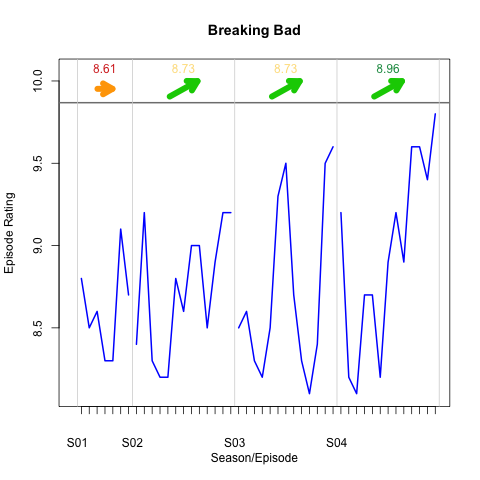
The blue line displays the IMDB rating of the episodes within each season - notice the break between seasons and the gray vertical bars delimiting seasons. There is a lot of data represented, so I've added some summary stats at the very top of each season:

  • the number at the very top is the average of the IMDB rating for all the episodes of the season. The color on a red-green scale compares the seasons to each other: the seasons with highest averages are green, those with worst ratings are red.
  • the arrow under the season average represents the evolution of ratings within the season: if episodes tend to get better and better the arrow will point upwards and be green, if they get worse the arrow will point downwards and be red. If the ratings remain approximately average over the season a horizontal orange arrow is displayed.

Revisiting the Friends visual, we observe spectacular consistency in ratings over the ten-year period. The summaries on top allow us to see through the noise, and that seasons 8 and 9 were among the worst in average episode rating as well as the only two that got worse over the season. But the tenth and final season was the highest-rated one, and had a strong positive trend until the series finale.

Although not a huge fan, I had to look at the Simpsons' incredible run. The visual highlights the surprising drop and plateau of the season average starting around the ninth season.


Now looking at some of my favorite series:
I have to agree here that the first seasons of 24 were the best. I also love the way ratings evolve in the final season, when people had very low expectations and thought it would be the same old jack-bauer-aka-superman-prevents-nuclear-attacks-every-thirty-minutes but soon realized this was Jack Bauer on a revenge rampage without any rules.


Breaking Bad is the perfect example of the TV series that keeps getting better, throughout the seasons and throughout the years. Can't wait for the second half of the fifth season!


The last few seasons of Dexter aren't rated as high as the first ones, but ratings remain high.


I loved the first season of Prison Break but clearly it should have been a one-season series, you jsut couldn't top the suspense and originality.


Game of Thrones started really high but just kept getting better à-la-breaking-bad. The seesaw effect in the third season is rather impressive!


Saturday, June 9, 2012

Is Dexter getting better?

My latest entries have mostly been basketball-focused but the highly anticipated playoff matchups are to be blamed for that!

So after my post on the Johnny Depp - Tim Burton collaboration, I would like to take a stab at tracking the evolution of TV series. I think there are a broad type of questions that can be considered, such as:

How does the rating of individual episodes evolve throughout the course of TV series lifetime? Are there really "good" and "bad" seasons? Do TV series get cancel when the ratings go down by too much? Is there a common threshold? Do all seasons have high-rated cliffhangers at the end of the season?

Data

Similarly to the Johnny Depp analysis, I will be extracting my data from IMDB. To start off, I will focus on one particular TV series (and personal favorites): Dexter.

Plot

Let us plot the evolution of the individual episode ratings by "time":
Two main insights stand out:
  • there appears to be a "seasonal" pattern within each season:
    - the ratings either stay flat or go down in the first few episodes
    - the ratings then shoot upwards during the second half of the season
  • after 5 seasons of overall similar quality, it appears that the last season has not performed as well. For the first time in over 5 years ratings dropped before 8.0, and even the strong season finale was the lowest-rated finales.
If we compare the distribution of season 6's ratings with those of all prior seasons, the difference jumps out:
The best season 6 episode has a rating barely greater than the median rating of all past seasons!

I will start looking at other TV series and see if an overall low-rated season is the beginning of the end (hopefully not!). Do networks quickly panic and cancel shows as soon as they start dropping in overall quality?